Göbeklitepe’s First Intact Burials Change the Bone Story
Two intact burial contexts, excavated in 2017 and 2022, offer a new explanation for scattered human bones at Göbeklitepe. Erosion is a hypothesis—not the whole story.
The Discovery
Göbeklitepe’s famous stone enclosures have yielded human bones for years—but mostly as scattered fragments, not intact graves. In a PLOS ONE study published on 22 September 2026, bioarchaeologist Julia Gresky and archaeologist Lee Clare describe the first two intact burial contexts identified at the site, dating to the Pre-Pottery Neolithic B, roughly 8700–8000 BCE.
These are not graves uncovered this morning. One collective burial was excavated in 2017 during drainage work for a protective shelter. The other skeleton was first noticed in 2012 and excavated in 2022. The news is the published analysis of how these contexts might illuminate a long-running puzzle.
Two Different Ways to Bury the Dead
Beneath the plaster floor of a rectangular building, the 2017 excavation revealed a pit containing remains of at least three people. Their bones had been rearranged: skulls lay toward one corner, with other skeletal elements gathered elsewhere. The team notes a possible fourth person, but does not count that as established.
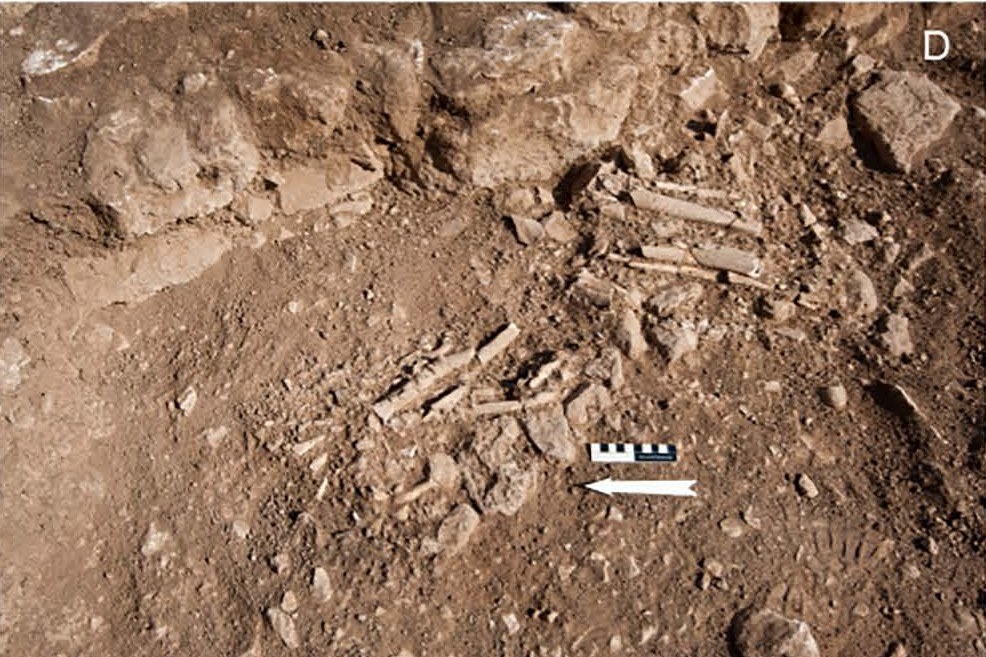
Near one of the monumental buildings, the 2022 excavation documented a single flexed skeleton, lying on its left side and facing east. It rested on stones without a clearly defined burial pit. Neither context is a licence to assign one uniform funeral ritual to everyone at Göbeklitepe.
The 928-Piece Question
Outside these two contexts, the researchers report 928 mostly unrelated human bone fragments recovered from fills and spaces across the excavation area. Some show evidence of deliberate human treatment; natural damage also matters. For years, the question has been whether remains were intentionally selected and placed in building fills, displaced from nearby burials, or both.
Gresky and Clare propose that slope deposits and erosion could have carried bones from originally intact burials higher on the mound into lower-lying monumental structures. The new graves make such a source plausible. They do not prove that every fragment took that route, or rule out other mortuary practices. Earlier explanations of some building fills as deliberate backfilling remain part of the archaeological debate, not a settled universal fact.
Intact graves give scattered bones a possible starting point—not a final answer.
What Changes
The finds add human-scale evidence to a site often reduced to its enormous pillars. The authors argue that subfloor burials also support a more complex picture of domestic life alongside monumental activity. Which bones were moved by people, which travelled with sediment, and how practices varied through time remain questions for excavation and analysis—not answers hidden in the stones.
Image: Cropped from Figure 3D of Gresky and Clare (2026), photograph J. Gresky / DAI. CC BY 4.0; crop and JPEG recompression by JitterSnap. This is the single interment excavated in 2022, not the collective burial.